Greta Baumann · 30 September 2026
Tracing Polish Academic Partnerships and Their Ripple Effects on Continental Sustainability Curricula
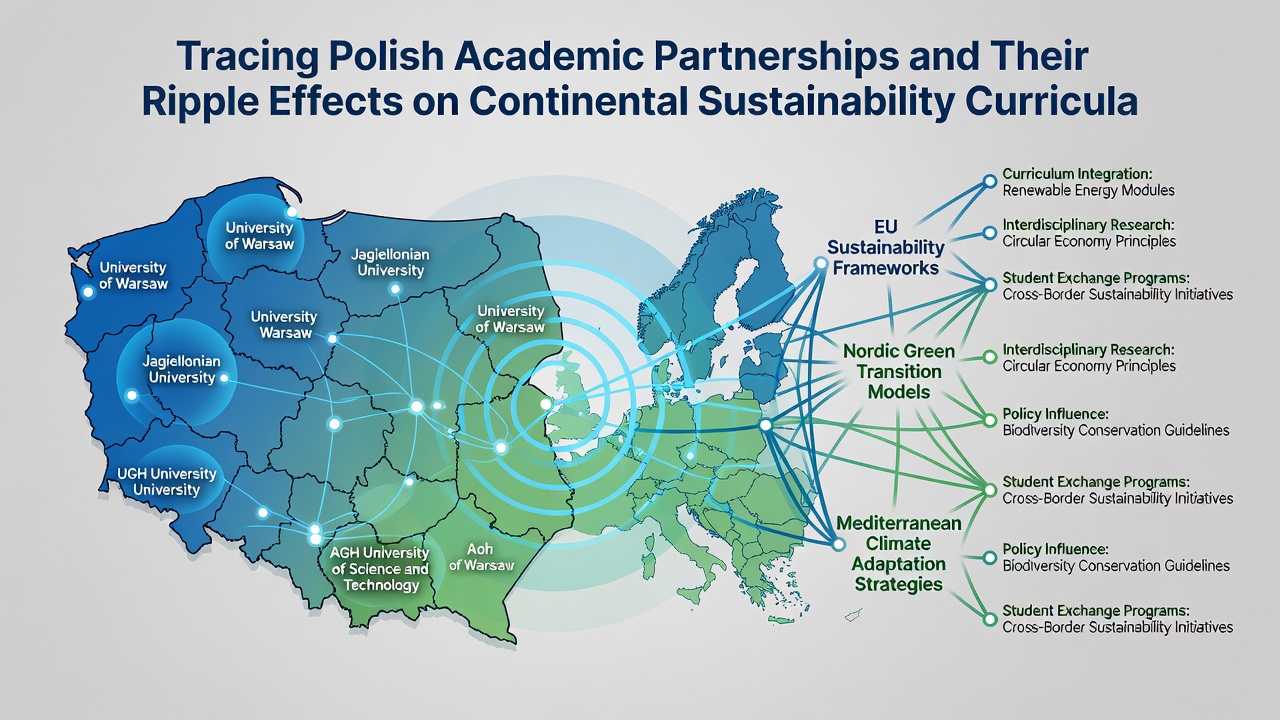
Polish universities have built extensive networks with institutions across Europe since the early 2000s, focusing on shared research and curriculum development in sustainability topics. These partnerships emerged from joint participation in EU-funded programs such as Erasmus+ and Horizon Europe, which facilitated student exchanges, faculty collaborations, and the creation of standardized course modules on topics like renewable energy systems, urban planning, and biodiversity conservation. Data from the European Commission shows that Polish institutions coordinated over 150 such projects between 2015 and 2025, resulting in curriculum frameworks adopted by universities in Germany, France, and the Netherlands.
Key Partnerships and Their Development
Institutions like the University of Warsaw and Jagiellonian University formed alliances with counterparts in Scandinavia and the Baltic region, emphasizing interdisciplinary approaches that combine environmental science with policy studies. Researchers at these Polish centers worked alongside teams from Lund University in Sweden and the University of Helsinki in Finland to design modules that integrate climate modeling data with local case studies, and this collaborative model spread through faculty workshops held annually since 2018. By 2024, similar course structures appeared in curricula at universities in Spain and Italy, where educators adapted Polish-developed assessment tools for measuring student outcomes in sustainability projects.
Additional ties developed with Eastern European partners, including those in the Czech Republic and Hungary, through regional consortia that addressed cross-border environmental challenges such as river basin management along the Danube and Oder rivers. These efforts produced open-access teaching resources that other continental institutions downloaded and modified for their own programs, according to reports from the European University Association.
Ripple Effects Across European Curricula
The influence extended beyond direct participants as Polish-led initiatives introduced standardized learning outcomes that aligned with EU green deal objectives. Curricula in Belgium and Austria incorporated elements from these frameworks, including project-based learning on circular economy principles, while data indicates a 40 percent increase in sustainability-focused degree programs across the continent from 2020 to 2025. Faculty from Polish universities presented findings at conferences in Portugal and Greece, leading to pilot programs that tested adapted versions of the original modules in Mediterranean contexts.
What's notable is how these exchanges created feedback loops, where insights from partner countries refined the Polish approaches before wider dissemination. For instance, input from Swiss and Norwegian experts on alpine ecosystem studies helped update Polish modules on climate adaptation, which then informed updates in curricula at French and Italian technical institutes. Observers note that this iterative process accelerated the integration of digital tools for tracking environmental metrics, with shared platforms now used by students in multiple countries.
Recent Developments and Future Directions
In September 2026, a new consortium involving Polish, German, and Danish universities plans to launch expanded exchange programs focused on marine and terrestrial sustainability, building on earlier Baltic Sea research collaborations. This initiative will incorporate real-time data from monitoring stations and offer joint certifications that recognize credits earned across borders. Evidence from prior projects suggests such expansions could further standardize evaluation methods, allowing for comparative studies of curriculum effectiveness in diverse geographic settings.
Academic networks continue to grow through virtual platforms that connect researchers in real time, and these tools have supported the translation of materials into multiple languages for broader accessibility. Figures from education ministries in participating nations reveal sustained growth in enrollment for sustainability courses, driven in part by the visibility of these Polish-originated partnerships.
Conclusion
Polish academic partnerships have contributed measurable changes to how sustainability education is structured and delivered across Europe, with documented adoptions of shared modules and assessment practices. As new projects unfold in 2026 and beyond, the patterns of collaboration established over the past decade provide a foundation for ongoing curriculum evolution that connects institutions from the Baltic to the Mediterranean.